Health Promotion Strategies & Future Trends
Due to the vast number of health risks associated with smoking, the concern for the health and wellbeing of Australians continues to grow. Strategies such as the Tobacco Advertising Prohibition Act 1992 and the National Tobacco Campaign have been put in place by the Australian government in an attempt to combat the prevalence of smoking within Australia.
(Tables 1&2 and graph 1 from (Health, 2015))
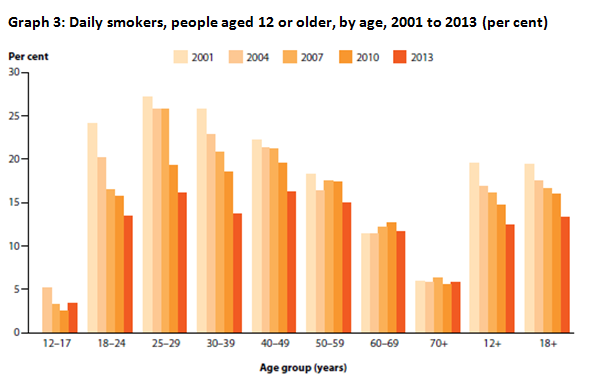
(Graphs 2&3 from(Welfare, Unknown))
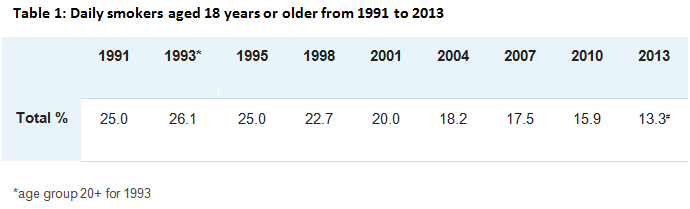
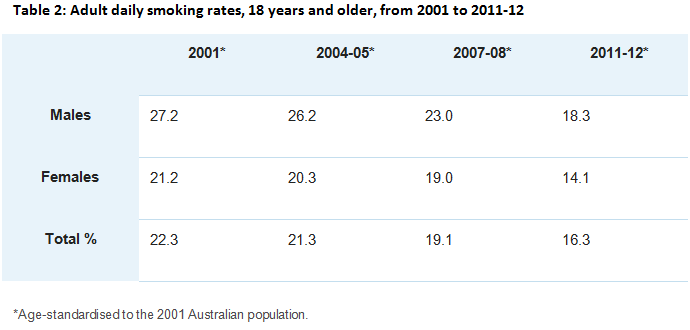
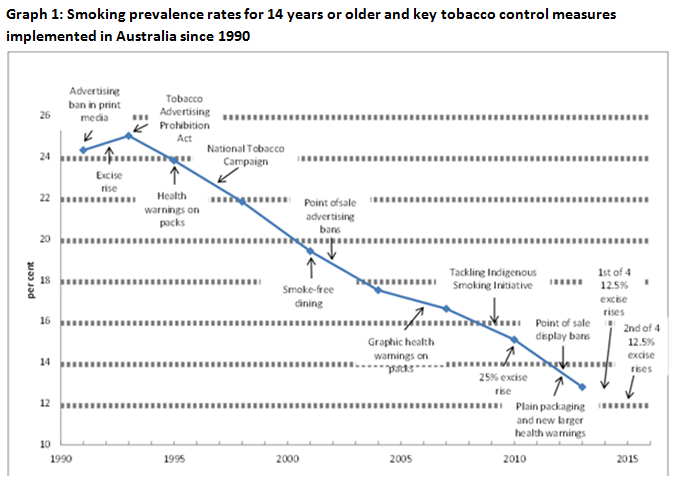
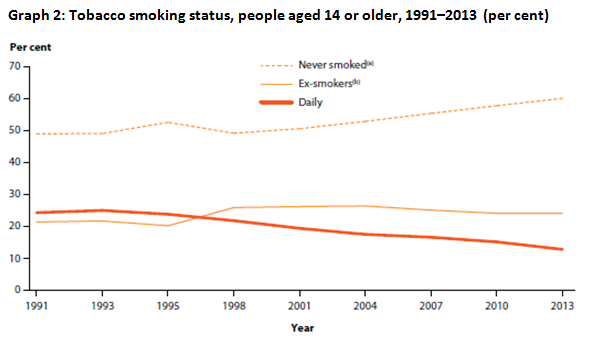
As can be observed in table 1, in 1991 the percentage of daily smokers aged 18 years or older reached almost a quarter of the Australian population. Over the next two years, the percentage increased by 1.1%, showing a minor increase in the popularity of smoking which then equally decreased by 1995. Since then, both table 1 and graph 1 show a steady decline with an average decrease of approximately 1.7% each year until 2013. Table 2, on the other hand, although supporting this decline, shows the total percentages to be higher though not by a significant amount. It can be seen in this table that the percentage of smokers who are males has proven to be higher than the percentage of female smokers. Similarly, graph 2 and 3 show a similar decline in smoking rates, though the changes are less identifiable.
In 1992, the Australian government released the Tobacco Advertising Prohibition Act 1992 with intentions to “...limit the exposure of the public to messages and images that may persuade them: (a) to start smoking, or to continue smoking; or (b) to use, or to continue using, tobacco products.” in order to improve public health (Government, 2015). As can be observed in graph 1, the percentage of smokers in Australia was close to 25%, following an approximate incline of 0.8% since 1991. However, it can also be seen that after the release of this act, numbers dropped significantly, following a steady decline until 2013.
The National Tobacco Campaign, launched in 1997 was Australia’s first national campaign (Tobaccoinaustralia.org, Unknown). By raising awareness of the harms of smoking through multiple forms of media, the National Tobacco Campaign aimed to decrease the rate of adult smokers to 10% by 2018. As can be seen in graph 1, the percentage of smokers in 1997 was close to 23.5%, having decreased by only 1.5% since 1991. However, since the campaign, the number of adult smokers continued to decrease steadily, reaching 13.3% (according to table 1) by 2013. It can be seen through this that the percentage of smokers is approximately 3.3% away from their performance benchmark. If the rate of smokers continues to decrease by approximately 1% each year, the percentage of smokers will reach 10.3% by 2016, and 8.3% by 2018.
It can be drawn from these observations that the implementation of health promotion strategies has had a significant effect on the prevalence of smoking within Australia, thus proving these strategies to be effective. If the government continues to implement strategies and campaigns such as these, it can be predicted that smoking rates will continue to decline as more people become aware of the risks caused by smoking. Furthermore, this diminution may result in a decreased likelihood of smoking being taken up in the first place. The beginnings of this can be observed in graph 2, showing that as the percentage of daily smokers decreased, the percentage of ex-smokers increased, and the number of those who had never smoked, increased quite significantly and continued to climb steadily. With this continued decline, it can be predicted that the number of smoking related deaths and illnesses will also decrease. Not only this but the number of people affected by second hand smoke, which can be just as damaging to the body and its maintenance of homeostatic balance, would be expected to decrease also.
Therefore, it can be concluded that the prevalence of smoking within Australia will continue to decrease. This will result in a further decrease of smoking related health issues as a result of an increased public awareness of the damages caused to the body by this detrimental lifestyle choice.
REFERENCES:
Government, A., 2015. Tobacco Advertising Prohibition Act 1992. [Online] Available at: https://www.comlaw.gov.au/Details/C2012C00734 [Accessed 25 July 2015].
Health, A.D.o., 2015. Tobacco key facts and figures. [Online] Available at: http://www.health.gov.au/internet/main/publishing.nsf/content/tobacco-kff [Accessed 20 July 2015].
Tobaccoinaustralia.org, Unknown. Social Marketing and Public Education Campaigns. [Online] Available at: http://www.tobaccoinaustralia.org.au/chapter-14-social-marketing/14-0-introduction [Accessed 24 July 2015].
Welfare, A.I.o.H.a., Unknown. Tobacco smoking in the General Population. [Online] Available at: http://www.aihw.gov.au/alcohol-and-other-drugs/ndshs-2013/ch3/ [Accessed 25 July 2015].
